
Managing Risk
Employers are required to maintain a physically and psychologically healthy and safe workplace. Identifying, assessing and controlling hazards is the foundation of workplace health and safety, as required by the Workers Compensation Act and Occupational Health and Safety Regulations.

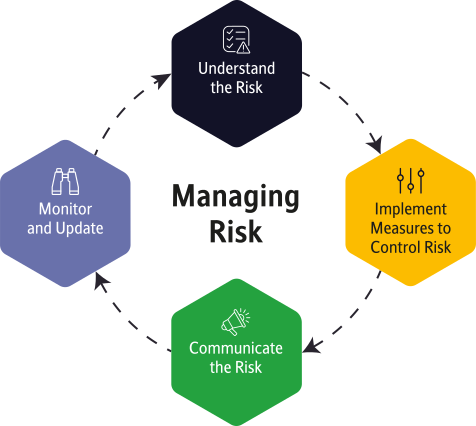
Managing Risk Steps
-
Complete Review of Managing Risks
Managing risk in your clinic involves considering what might cause harm to your staff and determining whether you, as the employer, are taking reasonable steps to prevent that harm from happening.
Be on the Lookout for Hazards
-
Identify Hazards in the Workplace
Managing risk begins with identifying workplace hazards, which can be accomplished by:
- Walking through the site to observe how tasks are performed
- Assessing activities, processes, equipment, and substances used by workers
- Consulting workers about any health and safety issues they’ve experienced
- Reviewing incident and first aid records
There are four main categories of hazards: physical, chemical, biological and psychosocial.
PHYSICAL HAZARDS - Tasks or workplace conditions that can cause injury through physical contact or exposure to energy, force, or unsafe conditions. Musculoskeletal injuries - strains, sprains, inflammation (e.g., handling heavy or awkward objects, repetitive motions, awkward body positions, poor lighting, heat/cold stress, cluttered workstation) Slips, trips, and falls (e.g., wet or uneven flooring, poor housekeeping) Puncture (e.g., medical sharps) Trauma (e.g., violence from an aggressive or threatening patient, explosion or projectile from compressed substance) Burns (e.g., cautery equipment, autoclave, kitchenware) Electrical shock (e.g., poor wiring or frayed cords) Fatigue (e.g., excessive noise, poor lighting, temperature, humidity) Crush (e.g., heavy objects) Injuries from emergencies (e.g., fire, earthquake, flood) Vibration or radiation (e.g. vortex mixers or x-ray machines) CHEMICAL HAZARDS - Substances that can cause harm through inhalation, ingestion, or skin contact. Chemicals used to disinfect and sterilize Liquid nitrogen Gases and pressurized containers (e.g., carbon dioxide, anesthetic gases, fire extinguisher) Chemicals used for preservation (e.g. formaldehyde) Latex Dusts (e.g., cast dust) Mercury (e.g., thermometers or sphygmomanometers) Hazardous drugs BIOLOGICAL HAZARDS - Microorganisms or biological material that pose a risk of infection, allergy, or toxicity to humans. Viruses, bacteria, and fungi (e.g., contaminated surfaces, contaminated medical sharps, blood and body fluids, airborne pathogens) Allergens Moulds PSYCHOSOCIAL HAZARDS - Aspects of work design, organization, or social interaction that can negatively impact psychosocial health or social functioning. Workplace violence from the public (e.g., aggression, threats) Bullying, embarrassment, and harassment from colleagues or supervisors Stress (e.g., workload, lack of support, deadlines, ineffective communication, crowdedness, working alone – first to arrive or last to leave, driving to and from work) Fatigue and burnout (e.g., long hours, lack of flexibility, work-life imbalance, lack of natural light) Lack of recognition
Hazard Risk Assessment and Controlling Risks
-
Complete Hazard Risk Assessment
After identifying the hazards in your workplace, evaluate the risks they pose to workers. This helps you assign the right level of attention and control to each hazard.
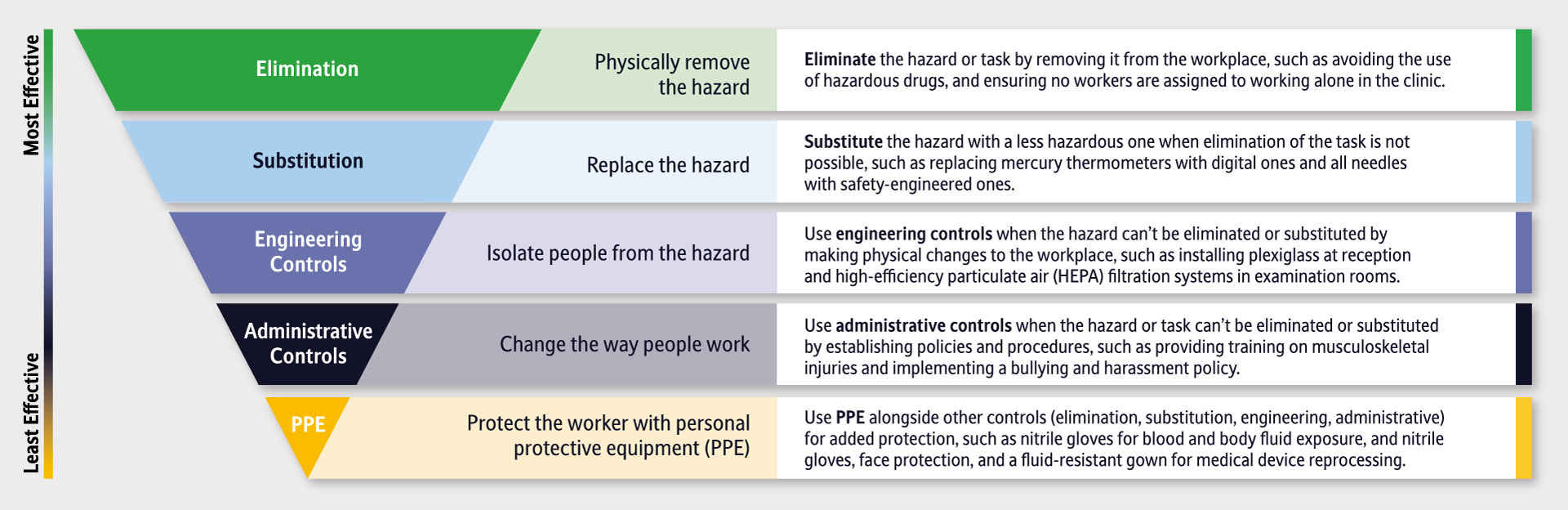
Once the risk before control is evaluated, the next step is to control the hazards and lower the risk. If elimination isn’t possible, implement the next most effective control measures to minimize the risks.
The hierarchy of controls can help you select and implement more effective measures to mitigate health and safety risks in your workplace. Personal protective equipment is the last line of defence as it does not remove or reduce hazards and should be used with other controls.
Although the controls are listed in order of effectiveness, all five types should be considered. They often work best when used together. Using multiple layers of controls to manage risks is more effective than using just one.
Hazard risk assessments should be completed annually or reviewed sooner if there are any changes in the operations of the business.